Your Security Cameras Can Do More Than Record an Emergency. They Can Help Identify One.
Every day, millions of students enter classrooms, employees report to work, and families visit public buildings with the expectation that these environments are safe.
Yet school administrators, city officials, and security professionals face an increasingly important question:
If someone enters your facility carrying a visible weapon, how quickly would your security team know?
For many organizations, the answer depends on someone noticing the threat, recognizing the danger, and communicating that information to the appropriate authorities.
Traditional surveillance cameras provide valuable evidence and situational awareness. However, without specialized analytics and monitoring, they typically depend on someone actively watching the video to identify a developing threat.
What if your existing cameras could help identify visible firearms and knives before an incident escalates?
That is the opportunity presented by ZeroEyes' expanded AI-powered Visual Threat Detection (VTD) technology.
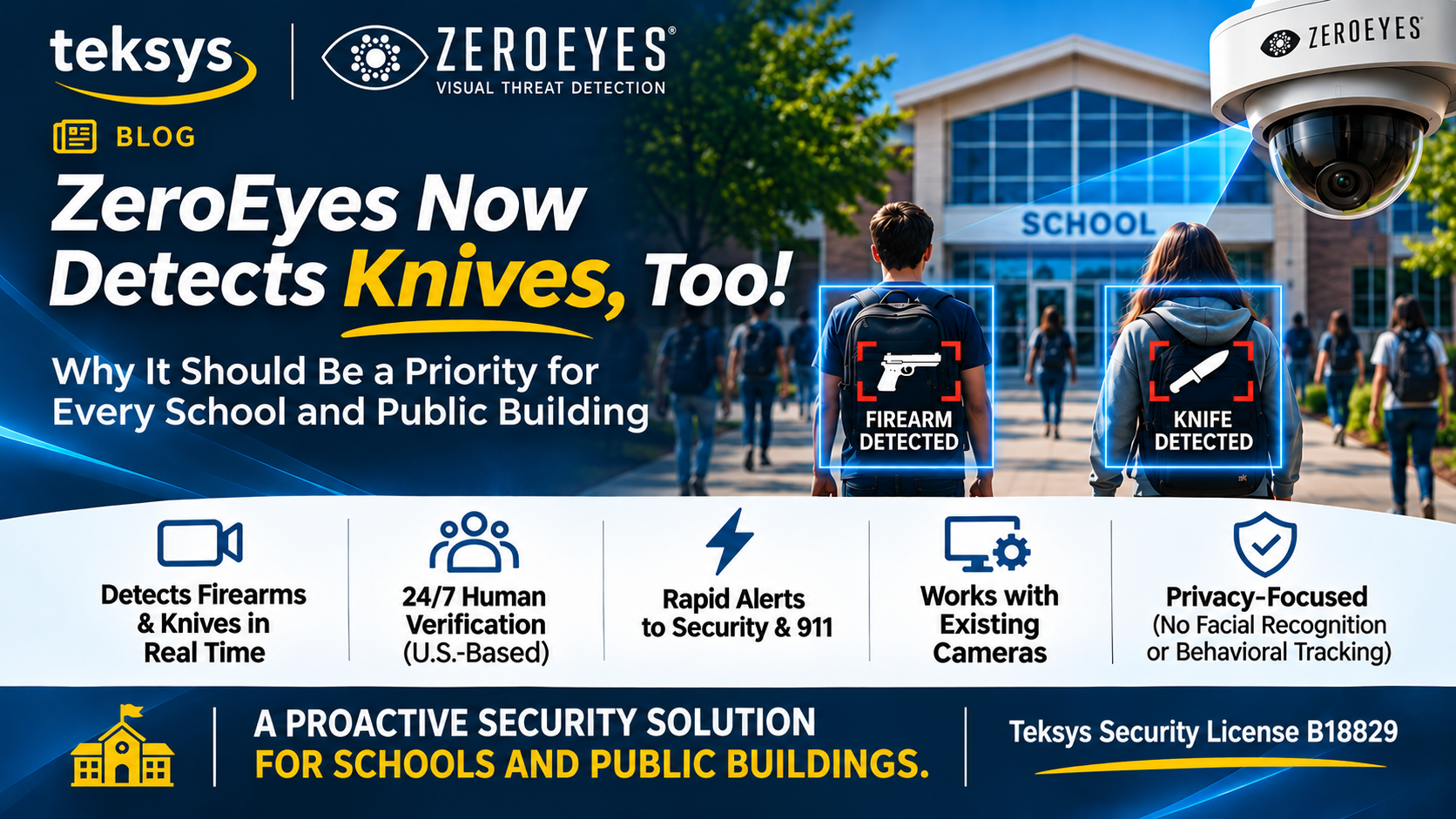
ZeroEyes Now Detects Both Firearms and Knives
ZeroEyes, known for its AI-powered firearm detection technology, has expanded its capabilities to include Visual Knife Detection.
This advancement allows security professionals to use compatible existing surveillance cameras to identify two important categories of visible weapon threats:
-
Firearms: Detecting visible, brandished firearms that may indicate an emerging threat.
-
Knives: Detecting visible, brandished knives that may present an immediate danger to students, employees, or visitors.
By combining artificial intelligence with human verification, ZeroEyes provides an additional layer of awareness that can help security personnel and first responders make more informed decisions.
For schools, colleges, government buildings, and other public facilities, this means existing camera infrastructure may now support a broader proactive threat detection strategy.
Why Knife Detection Matters for School Safety
When discussing school security, conversations frequently focus on firearms. However, threats involving knives and other bladed weapons also deserve attention.
A dangerous situation involving a knife can develop quickly, particularly in crowded environments such as hallways, cafeterias, school entrances, and common areas.
School security personnel cannot physically monitor every location simultaneously. Even facilities with extensive surveillance coverage may have blind spots in their ability to recognize threats in real time.
Having cameras installed is not the same as having an automated threat detection system.
ZeroEyes Visual Threat Detection helps address this challenge by continuously analyzing video from designated cameras for visible, brandished firearms and knives.
When a potential weapon is detected, the system initiates a human verification process and, when verified, communicates actionable information to the appropriate security personnel and emergency responders.
This capability can provide valuable additional time to initiate established emergency procedures.
Importantly, the technology complements rather than replaces school resource officers, trained security personnel, access control, emergency communications, and comprehensive safety planning.
How ZeroEyes Visual Threat Detection Works
ZeroEyes combines computer vision analytics, continuous monitoring, human verification, and rapid notifications.
1. AI-Powered Weapon Detection
ZeroEyes analyzes video streams from compatible security cameras to identify visible, brandished firearms and knives.
The system operates continuously, 24 hours a day, 365 days a year.
2. Human Verification
Potential detections are reviewed by ZeroEyes' U.S.-based operations team, staffed by military and law enforcement veterans.
According to ZeroEyes, verification can occur in as little as 3–5 seconds.
This human-in-the-loop approach helps distinguish potential threats from false detections before alerts are dispatched.
3. Rapid Threat Notification
Once a threat is verified, notifications can be delivered to designated security personnel and local emergency dispatch centers through supported ZeroEyes applications, integrations, and communication procedures.
Alerts can include actionable information such as images, weapon descriptions, and location details to support situational awareness.
4. Faster, More Informed Response
By receiving verified threat information sooner, security personnel and first responders may be better positioned to implement emergency response procedures.
The objective is simple: Identify potential danger earlier, communicate it quickly, and give responders more time to act.
Detection does not guarantee that an incident will be prevented, but it can strengthen an organization's overall emergency readiness.
Why Every School Should Evaluate Visual Threat Detection
Schools already invest significant resources in surveillance cameras, access control, intercoms, emergency notifications, and security personnel.
Yet many of these systems operate independently or provide information primarily after an incident has begun.
Visual Threat Detection offers an opportunity to make existing surveillance investments more useful.
For school districts, the potential benefits include:
Greater awareness: Identify visible weapon threats without relying exclusively on personnel watching live video.
Better use of existing cameras: Add compatible AI analytics without necessarily replacing the entire surveillance system.
Faster communication: Provide verified information to security personnel and emergency responders.
Support for emergency planning: Integrate detection and notification into established school safety procedures.
Privacy-conscious technology: ZeroEyes states that its solution does not use facial recognition or behavioral tracking.
For school IT directors, this also creates an opportunity to contribute directly to campus safety using infrastructure they already manage.
Instead of asking only how many cameras are installed, administrators should also ask:
How effectively are those cameras helping us recognize and respond to a threat?
Public Buildings Need Proactive Protection, Too
The benefits of Visual Threat Detection extend beyond schools.
Government facilities, libraries, community centers, transit stations, healthcare facilities, and other publicly accessible buildings face similar challenges.
Many must balance open public access with the need to protect employees and visitors.
ZeroEyes can provide another layer of situational awareness in locations such as:
-
Municipal buildings: City halls, administrative offices, and public service facilities.
-
Libraries and community centers: Buildings serving families and large numbers of visitors.
-
Higher education campuses: Academic buildings, student centers, and other common areas.
-
Healthcare facilities: Hospitals, clinics, and other facilities with publicly accessible spaces.
-
Transit facilities: Stations, terminals, and transportation centers.
-
Commercial and industrial properties: Corporate campuses, manufacturing facilities, and distribution centers.
For public safety directors and facility managers, the ability to detect visible weapon threats through existing cameras can become an important component of a broader security modernization strategy.
You May Already Have Much of the Infrastructure You Need
One of the most compelling aspects of ZeroEyes is its ability to work with compatible existing IP surveillance systems.
Organizations may not need to replace all their cameras or completely redesign their video security infrastructure.
Instead, a deployment assessment can determine whether their existing cameras, network, and video management system meet the requirements for ZeroEyes integration.
Considerations include camera resolution, image quality, field of view, network connectivity, available power, and placement of the ZeroEyes analytics appliance.
ZeroEyes identifies minimum camera requirements that include 720p resolution, 5 frames per second, 16:9 aspect ratio, and ONVIF compatibility.
Actual detection performance and suitability depend on camera placement, visibility, environmental conditions, and the specific deployment design.
This makes a professional site and infrastructure assessment an important first step.
Why Waiting Until After an Incident Is the Wrong Time to Evaluate Security
Fire alarms, intrusion detection systems, and emergency notification platforms are installed because organizations recognize the value of early warning.
Visual weapon detection deserves consideration through the same preparedness mindset.
A security system should not simply document what happened. Wherever technically feasible, it should also help security teams recognize emerging danger and respond appropriately.
The time to evaluate a threat detection system is before an emergency, not during one.
For schools and public facilities, that means reviewing existing camera coverage, identifying priority areas, assessing integration opportunities, and determining how verified alerts would fit into emergency response procedures.
It also means understanding the limitations of the technology and ensuring it forms part of a comprehensive security program.
How Teksys Helps Texas Schools and Public Facilities Implement ZeroEyes
At Teksys, Inc., we specialize in designing, deploying, and integrating advanced physical security and wireless connectivity solutions.
As part of our commitment to helping Texas communities improve public safety, we offer ZeroEyes Visual Threat Detection solutions for educational institutions, municipalities, and commercial facilities.
Our team can assist with:
-
Existing Camera Assessments: Evaluate whether your current surveillance infrastructure can support ZeroEyes.
-
System Design and Integration: Identify camera coverage requirements and coordinate integration with compatible security infrastructure.
-
Network Readiness: Review connectivity, bandwidth, power, and equipment requirements.
-
Implementation Planning: Develop a deployment strategy based on your facilities, priorities, and budget.
-
Security System Modernization: Identify opportunities to strengthen your overall surveillance and emergency notification capabilities.
Teksys also offers purchasing options through Texas DIR and TIPS cooperative procurement contracts, subject to applicable contract scope and purchasing requirements.
Our goal is to help organizations make informed decisions about technologies that can improve safety while maximizing the value of their existing infrastructure.
The Next Step in School and Public Building Safety Starts With a Conversation
The introduction of knife detection represents another important advancement in AI-powered physical security.
For schools and public buildings, the question is no longer simply whether surveillance cameras are installed.
The question is whether those cameras are being used to their full potential to help protect people.
ZeroEyes Visual Threat Detection provides an opportunity to move beyond passive video recording toward earlier threat identification and more informed emergency response.
Every school district, municipality, and public facility should consider whether this technology belongs in its security strategy.
Don't wait for an emergency to discover what your cameras could have helped you see.
Let Teksys Help You Evaluate Your Options
Whether you're a school superintendent, IT director, security administrator, city official, or concerned parent, our team would welcome the opportunity to explain how ZeroEyes works and discuss practical ways to bring this technology to your facilities.
Contact Teksys today to schedule a ZeroEyes Visual Threat Detection consultation.
https://www.teksys.com/contact-us
Teksys, Inc. | Custom Connectivity & Security Solutions
Security License B18829
Teksys + ZeroEyes: Faster Alerts. Smarter Detection. Safer Communities.
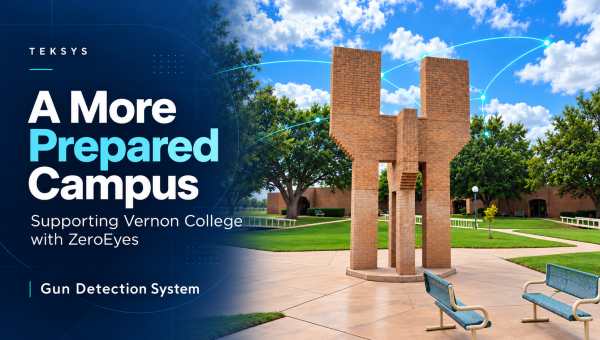
A safer campus starts with preparation—and technology that helps people recognize and respond to threats. Teksys, Inc. helped facilitate the deployment of ZeroEyes AI gun detection and intelligent situational awareness software at Vernon College, adding another layer to the college’s comprehensive approach to campus safety.
The deployment supports Vernon College’s commitment to protecting students, faculty, staff, and visitors while maintaining a welcoming environment for learning.
Supporting a proactive approach to campus safety
Vernon College serves approximately 2,300 students across a 12-county service area, with campuses in Vernon and Wichita Falls, Texas. Its security strategy already includes a campus-wide camera system, AlertMedia emergency mass notification technology, direct radio communication with local law enforcement in both communities, and specialized protective equipment for campus police officers.
ZeroEyes adds gun detection and human verification to that strategy, helping campus officials and law enforcement receive information they can use to assess and respond to a potential threat.
“At Vernon College, protecting our students, faculty, and staff is central to everything we do,” said Dr. Dusty R. Johnston, President of Vernon College. “We continually evaluate and adopt resources that improve our ability to respond decisively in critical situations. ZeroEyes strengthens our overall safety approach and supports a more prepared and responsive campus environment.”
How ZeroEyes supports threat detection and response
ZeroEyes software layers onto existing digital security cameras to identify visible guns. When the software detects a potential gun, images are immediately sent to the ZeroEyes Operations Center for review.
The center operates around the clock and is staffed by specially trained U.S. military and law enforcement veterans. If reviewers determine that a threat is valid, they dispatch alerts and actionable information to law enforcement and school officials.
That information can include a visual description, gun type, and last known location, often delivered within seconds of detection. Pairing AI detection with human review helps provide responders with context as they determine their next steps.
Teksys’s role as a technology partner
As a Houston-based security systems and connectivity solutions provider, Teksys worked to facilitate the ZeroEyes deployment at Vernon College. Our approach centers on helping clients put technology to work in support of their operational needs and the communities they serve.
“ZeroEyes represents the kind of solution every campus should consider as part of a modern safety strategy,” said David Madrigal, Teksys Inc. senior engineer. “Vernon College stands out for its proactive mindset and willingness to invest in tools that support a safer learning and working environment for its community.”
ZeroEyes also recognized the collaboration behind the deployment.
“Teksys Inc. brings strong expertise in public safety technology implementation, and their collaboration has been instrumental in supporting Vernon College’s security infrastructure,” said Mike Lahiff, CEO and cofounder of ZeroEyes. “We’re pleased to partner with them to implement the ZeroEyes solution.”
Building a more prepared campus community
Vernon College’s investment illustrates how gun detection technology can complement existing cameras, emergency communications, and relationships with local law enforcement. Each element contributes to a broader effort to improve awareness and support a coordinated response.
At Teksys, we’re proud to support that effort through technology partnerships focused on public safety, education, and connectivity.
Contact Teksys to discuss how security and connectivity solutions can support your campus safety goals.
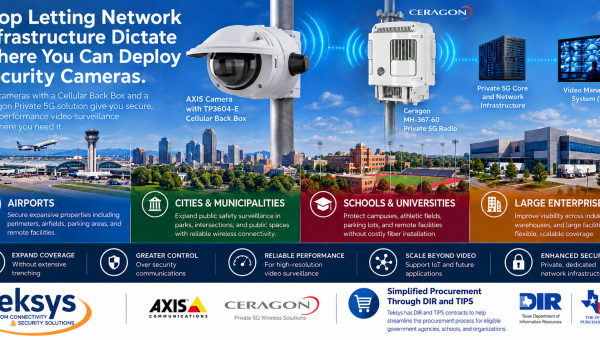
Deploy Security Cameras Where You Need Them, Not Just Where Network Cables Can Reach
The Challenge: Expanding Video Surveillance Without Expanding Infrastructure Costs
For airports, municipalities, school districts, and large enterprises, video surveillance has become an essential component of protecting people, facilities, and critical infrastructure.
However, expanding surveillance coverage across large properties presents a familiar challenge: How do you connect cameras in locations where traditional network infrastructure is unavailable, expensive to install, or difficult to maintain?
Consider the challenges facing today's security and IT professionals:
-
An airport needs additional cameras along its perimeter, remote parking areas, or airfield support facilities.
-
A city wants to expand public safety surveillance into parks, intersections, pedestrian corridors, and public spaces.
-
A school district needs to secure athletic fields, parking lots, and remote campus facilities.
-
A large enterprise wants to monitor expansive industrial sites, warehouses, and outdoor operational areas.
Traditionally, these projects require installing fiber-optic cable, constructing underground pathways, obtaining permits, and coordinating construction activities that can disrupt daily operations.
But what if organizations could significantly reduce their dependence on new wired infrastructure while maintaining the security, performance, and centralized management required for professional video surveillance?
The combination of Axis Communications cellular-enabled camera technology and Ceragon private 5G wireless networking provides a compelling alternative.
At Teksys, we believe this combination deserves serious consideration by organizations planning their next generation of security infrastructure.
Introducing the AXIS TP3604-E Cellular Back Box
Axis Communications has introduced the AXIS TP3604-E Cellular Back Box, a solution designed to connect compatible Axis network cameras directly to a private cellular network.
Rather than requiring a dedicated Ethernet connection back to a network switch, the cellular back box enables compatible Axis cameras to communicate over an organization's private 4G or 5G network.
The solution supports:
-
AXIS P32 Series dome cameras.
-
AXIS P14 Series bullet cameras, using the appropriate adapter plate.
-
Private cellular connectivity using a SIM card.
-
Outdoor installations with IP66 weather protection and IK10 impact resistance.
-
Integration with compatible video management platforms.
-
Video streaming throughput up to 200 Mbps at the back box, subject to available wireless network capacity.
The device also incorporates Axis cybersecurity technologies, including secure boot, encrypted storage, and hardware-based security features.
For organizations operating in the United States, the AXIS TP3604-E US model supports the CBRS frequency bands B48 and n48, providing a potential path for deployment on compatible private cellular infrastructure.
The important advantage is installation flexibility.
Where suitable private cellular coverage and electrical power are available, security cameras can be deployed without installing a new fiber or Ethernet connection to each location.
For example, an existing light pole with appropriate electrical power could become a new video surveillance location without requiring a trench across a parking lot or roadway.
This approach opens new possibilities for expanding security coverage across large and geographically dispersed environments.
Why Pair Axis Cameras with a Ceragon Private 5G Network?
While cellular-enabled cameras provide the connection to the network, the underlying wireless infrastructure determines how effectively that connection performs.
This is where Ceragon's private wireless networking solutions become especially valuable.
Ceragon provides end-to-end private 4G/5G wireless solutions designed for organizations requiring secure, high-performance connectivity across large or complex environments.
Unlike public cellular services, a private cellular network is designed around the organization's operational requirements.
This gives organizations greater control over network coverage, connected devices, traffic management, security policies, and network performance.
1. Expand Coverage Without Extensive Trenching
Installing fiber-optic infrastructure across airports, municipal properties, and industrial campuses can be expensive and time-consuming.
Construction may involve excavation, pavement restoration, underground utility coordination, permitting, and interruptions to normal operations.
With a properly designed Ceragon private cellular network, multiple camera locations can communicate wirelessly through strategically positioned radio infrastructure.
This can substantially reduce the amount of new cabling required and make previously impractical camera locations more accessible.
2. Gain Greater Control Over Security Communications
Public cellular networks serve thousands of users, and organizations typically have limited control over network congestion, resource allocation, and service availability.
A private 5G network provides a dedicated environment where authorized devices can connect under organization-defined security and operational policies.
This is particularly valuable for public safety and critical infrastructure applications, where organizations want to maintain control over how surveillance information moves across their network.
Private SIM authentication, network segmentation, and appropriately configured encryption can help protect communications while supporting centralized network administration.
3. Support Reliable Video Surveillance Performance
Professional video surveillance places significant demands on network infrastructure.
Multiple high-resolution cameras can generate substantial upstream traffic, particularly when video is transmitted continuously to a centralized video management system.
A properly engineered private 5G network can prioritize critical applications, allocate network resources, and support predictable performance under planned operating conditions.
Unlike general-purpose wireless connectivity, a purpose-designed private network can be engineered around surveillance bandwidth, coverage, latency, and availability requirements.
Performance still depends on radio conditions, spectrum availability, network capacity, and traffic engineering, making professional system design essential.
4. Scale Beyond Video Surveillance
One of the most compelling benefits of investing in private 5G infrastructure is its potential to support applications beyond security cameras.
The same private network may also support compatible:
-
IoT sensors and environmental monitoring systems.
-
Operational communications and remote equipment monitoring.
-
Smart city and transportation technologies.
-
Connected industrial devices.
-
Emergency management and mobile applications.
Instead of constructing separate wireless systems for every new application, organizations can establish a shared communications foundation designed to support future requirements.
Real-World Applications: Where This Technology Makes Sense
Airports: Secure Large Properties Without Disrupting Operations
Airports present some of the most challenging environments for surveillance infrastructure.
Their expansive properties include airfields, perimeter fencing, parking facilities, maintenance areas, cargo facilities, and remote access roads.
Installing traditional network cabling in these locations can be complicated by construction restrictions, operational requirements, and the need to minimize disruption.
A Ceragon private 5G network combined with compatible Axis cameras can provide an alternative approach for connecting cameras in areas where network cabling is impractical.
Potential applications include perimeter surveillance, remote parking facilities, service roads, cargo areas, and temporary construction zones.
The ability to deploy additional surveillance locations using existing electrical infrastructure can be particularly valuable when responding to changing security requirements.
Cities and Municipalities: Expand Public Safety Video Coverage
Cities increasingly depend on video surveillance to improve situational awareness, support emergency response, and monitor public spaces.
However, public safety camera locations do not always align with existing municipal fiber networks.
Parks, intersections, pedestrian corridors, parking facilities, and other public spaces may be located far from available communications infrastructure.
Private 5G enables municipalities to consider a different approach.
Rather than extending fiber to every new camera, cities can establish private wireless coverage and connect compatible cameras wherever suitable network coverage and electrical power are available.
This approach can help municipalities:
-
Expand public safety surveillance more efficiently.
-
Connect cameras in parks and remote public facilities.
-
Reduce construction requirements at difficult locations.
-
Integrate remote camera feeds into centralized monitoring operations.
-
Establish communications infrastructure for future smart city applications.
For cities managing multiple departments and geographically dispersed assets, the ability to share a purpose-built wireless infrastructure may deliver significant long-term value.
Schools and Universities: Protect the Entire Campus
School districts and universities often operate facilities spread across multiple buildings, parking areas, athletic fields, and outdoor spaces.
Although many campuses have established network infrastructure inside their buildings, providing connectivity to outdoor locations can be significantly more challenging.
A private cellular network can extend communications coverage to areas that might otherwise require costly underground cabling.
Potential applications include:
-
Athletic stadiums and sports complexes.
-
Student and staff parking areas.
-
Remote campus entrances.
-
Bus transportation facilities.
-
Outdoor gathering areas.
-
Temporary buildings and construction projects.
For districts and universities with multiple surveillance expansion projects, private cellular technology offers an opportunity to evaluate a more flexible long-term network architecture.
It can also complement existing fiber and wireless infrastructure rather than requiring organizations to replace their current investments.
Large Enterprises: Improve Visibility Across Complex Facilities
Manufacturing plants, logistics centers, distribution campuses, energy facilities, and large commercial properties frequently need surveillance coverage across expansive outdoor environments.
These locations may include equipment yards, loading areas, remote gates, perimeter roads, and facilities where installing new communications pathways would interfere with operations.
Private 5G provides a potential solution for extending video connectivity without the limitations associated with deploying new physical cabling to every location.
For enterprise IT and security teams, the value extends beyond camera connectivity.
A private network can provide a common wireless foundation for security, operational monitoring, and future connected applications.
Private 5G vs. Fiber and Wi-Fi: Choosing the Right Technology
Private 5G is not intended to replace every wired or wireless network.
Fiber-optic infrastructure remains an excellent choice where high-capacity, dedicated connections are readily available. Wi-Fi continues to serve many indoor and localized applications effectively.
However, private 5G becomes particularly attractive when organizations need wide-area wireless coverage, controlled network access, and the ability to connect devices across large outdoor environments.
| Consideration | Fiber | Traditional Wi-Fi | Private 5G |
|---|---|---|---|
| New underground cabling | Often required | Not always required | Not required at camera locations |
| Wide outdoor coverage | Requires distributed physical infrastructure | Multiple access points may be needed | Designed for broad coverage |
| Mobility support | Limited | Available with appropriate design | Strong mobility capabilities |
| Dedicated network control | Yes | Yes, with proper configuration | Yes |
| Installation flexibility | Limited by cable pathways | Flexible within coverage | Flexible within cellular coverage |
| High-bandwidth performance | Excellent | Depends on design and interference | Depends on spectrum and capacity |
| Best application | High-capacity fixed infrastructure | Localized wireless connectivity | Wide-area and mobile connectivity |
The strongest architecture is often a hybrid approach, using fiber where it makes sense, private 5G where wireless coverage offers advantages, and existing networks wherever they can be leveraged effectively.
The Importance of Proper Network Design
Although the benefits of private 5G are compelling, successful deployments require more than simply installing cellular-enabled cameras.
Video surveillance is an uplink-intensive application. Network capacity must be evaluated based on camera resolution, compression settings, frame rates, expected traffic, and the number of simultaneous video streams.
Organizations should also consider:
-
RF coverage and interference analysis.
-
Spectrum availability and regulatory requirements.
-
Compatibility between camera cellular interfaces and private network equipment.
-
Power availability at camera locations.
-
Video management system integration.
-
Network security and authentication.
-
Redundancy and operational availability.
-
Long-term maintenance and support.
For example, the AXIS TP3604-E US supports specific private cellular frequency bands and standalone network modes. The selected Ceragon infrastructure must be verified for compatibility with these requirements.
Additionally, integrating cameras into an existing video management system may require defined IP addressing and network configuration rather than relying on traditional camera discovery protocols.
These considerations reinforce the importance of working with an experienced technology integration partner.
How Teksys Can Help
At Teksys, we specialize in combining advanced video surveillance technologies with high-performance wireless networking solutions.
Our experience in video surveillance, wireless backhaul, network infrastructure, and systems integration allows us to approach projects from both the security and communications perspectives.
By bringing together Axis Communications cameras and Ceragon private wireless networking technology, Teksys can help organizations evaluate and develop solutions tailored to their specific requirements.
Our services include:
-
Site Assessment and Feasibility: Evaluating coverage requirements, available infrastructure, camera locations, and potential deployment challenges.
-
Wireless Network Design: Developing private wireless architectures based on RF coverage, capacity, and operational requirements.
-
Video Surveillance Integration: Selecting compatible Axis cameras and integrating them with existing or new video management systems.
-
Installation and Commissioning: Deploying, configuring, testing, and optimizing the communications and surveillance infrastructure.
-
Ongoing Support: Providing maintenance, troubleshooting, and network performance support to help sustain system reliability.
Our goal is not simply to install more cameras. It is to help organizations develop surveillance systems that are practical to deploy, manageable to operate, and ready to accommodate future needs.
Simplified Procurement Through Teksys DIR and TIPS Contracts
At Teksys, we understand that selecting the right technology is only part of the process. For public agencies, educational institutions, and other organizations, navigating procurement requirements can be just as challenging as designing and deploying the solution.
To help streamline purchasing, Teksys offers procurement options through the Texas Department of Information Resources (DIR) and The Interlocal Purchasing System (TIPS).
These cooperative purchasing programs provide eligible customers with established contracting vehicles that can help simplify the acquisition of technology products and related services, reduce administrative burdens, and accelerate project implementation.
Teksys Texas DIR Contracts:
-
DIR-CPO-5287: Data Communications & Networking Equipment and Related Services.
-
DIR-CPO-5406: Mobile Digital Video Products & Accessories.
Teksys TIPS Cooperative Purchasing: Teksys also participates in the TIPS cooperative purchasing program, providing additional purchasing options for eligible organizations, subject to applicable contract availability and scope.
Teksys TIPS Contract:
-
260105: Technology Solutions, Products, and Services
Whether your organization is planning a municipal surveillance expansion, an airport security upgrade, a school campus improvement, or a large-scale wireless infrastructure project, Teksys can help identify an appropriate procurement pathway for the proposed equipment and services.
Our goal is to make the entire process easier, from initial system design and technology selection to procurement, installation, and ongoing support.
Contact Teksys to discuss your project and determine which available procurement contract may best support your organization's purchasing requirements.
The Future of Video Surveillance Is More Connected and More Flexible
The ability to place security cameras where they provide the greatest operational value, rather than where network infrastructure happens to exist, represents an important shift in surveillance system design.
Axis cellular-enabled camera technology and Ceragon private 5G networking offer organizations an opportunity to rethink how they extend video surveillance across large properties.
For airports, municipalities, school districts, and enterprises, the potential benefits include reduced infrastructure construction, more flexible deployment options, greater control over communications, and a scalable foundation for future connected technologies.
The question is no longer simply where you can install a security camera. It is where you need visibility, and what network architecture makes that visibility possible.
Ready to Expand Your Video Surveillance Coverage?
Whether you're responsible for securing an airport, municipality, school campus, or large enterprise, Teksys can help you explore how Axis cellular-enabled cameras and Ceragon private 5G networking can improve coverage while reducing dependence on costly wired infrastructure.
With Teksys's Texas DIR contracts and TIPS cooperative purchasing options, eligible organizations may also benefit from a more streamlined procurement process.
Schedule a consultation with Teksys today to discuss your security requirements, wireless network design, and available purchasing options.
Teksys, Inc. | Advanced Security & Wireless Connectivity Solutions
Texas Security License #B18829
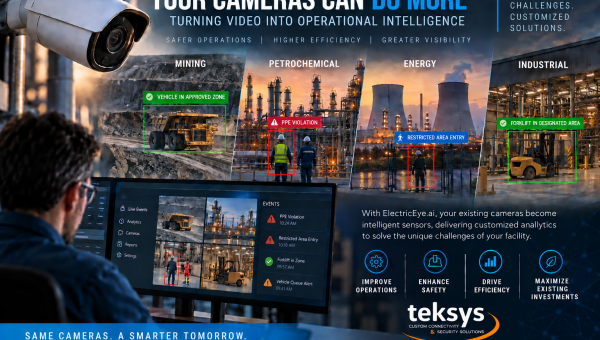
How AI Video Analytics Can Help Mining, Petrochemical, Energy, and Industrial Facilities Solve Problems Unique to Their Operations
Industrial facilities generate enormous amounts of operational data every day. Process control systems monitor pressures, temperatures, flow rates, equipment status, alarms, and thousands of other variables. Yet there is another source of operational information that many facilities already have deployed throughout their sites: video cameras.
Traditionally, those cameras have been treated primarily as security devices.
Artificial intelligence is beginning to change that.
Platforms such as ElectricEye can transform existing camera infrastructure into intelligent visual sensors capable of analyzing what is happening within a facility and identifying specific behaviors, conditions, and events that matter to operations.
Instead of asking, “What analytics came with this camera?” industrial organizations can begin asking a much more valuable question:
“What operational problem do we need to solve, and can our cameras help us detect it?”
That shift opens an entirely new category of possibilities for Process Control Engineers, Facility Managers, Operations teams, and Technology Managers.
From Video Surveillance to Visual Operational Intelligence
Most industrial facilities already have extensive instrumentation. PLCs, SCADA systems, DCS platforms, environmental sensors, access control systems, and other technologies provide critical information about the operation.
But traditional sensors only measure what they were designed and installed to measure.
A pressure transmitter knows pressure.
A flow meter knows flow.
A proximity sensor knows whether something crossed its detection point.
A camera sees an entire scene.
Until recently, extracting useful operational information from that video required a person to continuously watch it or review recordings after an event occurred.
Modern AI video analytics are changing that equation.
ElectricEye's Active Scene Intelligence™ is designed to analyze the context and behavior occurring within a camera scene rather than simply identifying motion or classifying individual objects. The platform can work with existing IP cameras and supported video management systems, with processing performed through its cloud-based architecture.
For industrial facilities, the important concept is not simply that AI can recognize a person, truck, forklift, or piece of equipment.
The real opportunity is teaching the system to recognize situations that matter to your particular operation.
Your Facility Does Not Have Generic Problems. Your Analytics Shouldn't Be Generic Either.
A mining operation, refinery, chemical plant, power generation facility, pipeline terminal, manufacturing plant, and bulk material facility may all use cameras.
But their operational challenges can be completely different.
This is where customizable AI analytics become particularly valuable.
Instead of deploying a fixed library of generic analytics, organizations can identify a specific operational condition and determine whether existing cameras provide enough visual information for AI to recognize it.
For example, an industrial facility might want to identify:
- A vehicle entering a restricted operating area while equipment is active.
- Workers entering a designated area without required PPE.
- Personnel approaching equipment during a hazardous operating condition.
- Trucks arriving at the wrong loading position.
- Vehicles remaining in staging areas longer than expected.
- Forklifts or mobile equipment operating in pedestrian zones.
- Material accumulating where it normally should not.
- A gate, cabinet, access panel, or equipment enclosure remaining open.
- Personnel crossing a defined safety boundary during an active process.
- Unexpected activity around remote infrastructure.
- A loading or unloading operation that appears to deviate from the normal sequence.
- Congestion developing around loading racks, gates, scales, or processing areas.
- Equipment or vehicles positioned somewhere they should not be.
The objective isn't to replace the facility's control systems.
It is to add another layer of operational awareness using visual information that may already be available.
A Different Approach: Start With the Problem, Not the Camera
For Process Control Engineers, perhaps the most interesting aspect of customizable video analytics is the ability to approach video much like another source of process information.
Consider a hypothetical bulk material operation.
The problem might be:
Trucks occasionally enter a loading area before the previous vehicle has completely cleared the operating zone.
A traditional video system records the event.
A basic analytic might detect that two trucks are present.
A customized behavioral analytic could potentially be designed around the actual operational condition:
Detect when a second vehicle enters the defined loading zone while another vehicle remains within the active loading position.
Now the camera isn't merely recording video.
It is effectively providing a new visual operational event.
That event could generate an alert, provide video evidence, and give operations personnel immediate context about what occurred.
This is where AI video analytics become much more interesting for industrial operations.
Mining: Seeing Operational Conditions Across Large Sites
Mining and aggregate operations present a particularly compelling environment for visual intelligence.
These facilities often combine enormous operating areas, heavy mobile equipment, haul roads, conveyors, crushers, loading zones, stockpiles, restricted areas, and relatively limited personnel coverage.
Customized analytics could potentially help monitor conditions such as haul-truck interactions, pedestrian proximity to heavy equipment, restricted-zone entry, loading activity, material movement, queue conditions, or unusual activity around remote infrastructure.
Instead of requiring operators to continuously monitor dozens of camera feeds, AI can watch for specifically defined conditions and bring the relevant event to their attention.
The camera network becomes another set of eyes across the operation, but eyes that never become distracted by the other 47 video tiles on a monitor.
Petrochemical Facilities: Adding Context to Complex Operations
Refineries, chemical plants, terminals, and petrochemical facilities operate under tightly controlled procedures where context matters enormously.
A person standing next to a piece of equipment may be perfectly normal during maintenance but unusual during another operating state.
A vehicle entering an area may be routine at 10:00 AM but significant during a transfer operation.
This is precisely why behavioral and contextual analytics are more interesting than simple motion detection.
ElectricEye describes its approach as analyzing the overall scene and relationships between objects and actions, allowing the platform to distinguish routine activity from conditions that warrant attention.
Potential applications could include monitoring PPE requirements, restricted operating areas, loading rack activity, vehicle movement, maintenance zones, perimeter conditions, access to remote equipment, or other visually identifiable operating procedures.
The goal is not another avalanche of alarms.
It is better context around the events that actually matter.
Energy Facilities: Extending Visibility to Remote Infrastructure
Power generation facilities, substations, renewable energy sites, pipeline infrastructure, compressor stations, tank farms, and other energy assets often include locations that are difficult or expensive to continuously staff.
Video analytics can provide an additional layer of situational awareness across these environments.
A camera that was originally installed for security might also help identify unauthorized personnel, unexpected vehicles, unusual activity around equipment, access to controlled zones, or other facility-specific conditions.
Because ElectricEye can connect with supported existing camera infrastructure rather than requiring an entirely separate sensor network, organizations may be able to extract additional operational value from investments they have already made.
Turning Existing Cameras into Multipurpose Sensors
This may be the most important concept for technology and facility managers.
Organizations have spent years installing cameras throughout industrial facilities.
Those cameras already have:
Power. Network connectivity. Field of view. Infrastructure. Maintenance processes.
Historically, their primary job was to record video.
AI creates an opportunity to make those same cameras perform additional jobs.
One camera might simultaneously contribute to:
Security: Is someone entering a restricted area?
Safety: Is a worker entering that area without the appropriate PPE?
Operations: Is a vehicle occupying the area when it should be clear?
Process improvement: How frequently does congestion occur at this location?
Management: Are recurring events identifying a larger operational bottleneck?
Suddenly, the ROI conversation around video infrastructure changes considerably.
From Real-Time Alerts to Operational Trends
The value of AI analytics doesn't stop when an alert is generated.
ElectricEye includes analytics capabilities for reviewing event activity, severity, camera performance, and trends over time.
For industrial organizations, aggregated information can sometimes be even more valuable than individual events.
Imagine discovering that a particular loading area generates three times as many vehicle conflicts as comparable areas.
Or that PPE exceptions repeatedly occur during a specific shift.
Or that a particular gate routinely experiences congestion between 6:30 and 7:15 AM.
Or that one operational zone produces a disproportionate number of safety-related events.
Those observations can move video analytics beyond incident response and into continuous operational improvement.
Process Control Engineers and Facility Managers can begin using visual data to ask:
Why does this keep happening?
And more importantly:
What can we change to prevent it?
Test the Analytic Before You Deploy It
Another important capability for industrial applications is the ability to test customized analytics against representative scenarios.
ElectricEye's platform includes simulated event testing that allows video to be analyzed using custom monitoring prompts before deploying the analytic into a production environment.
That creates an iterative engineering process:
Identify the operational problem → Define the desired visual condition → Test it → Validate the results → Refine the analytic → Deploy → Measure performance.
For engineering teams, this approach is far more useful than purchasing an analytic simply because it appears on a manufacturer's feature list.
The technology is being configured around the process rather than forcing the process to fit the technology.
AI Doesn't Replace Process Control. It Adds Another Instrument.
For Process Control Engineers, perhaps the best way to think about technologies like ElectricEye is not as another surveillance platform.
Think of the camera as a software-defined visual sensor.
PLCs, SCADA, DCS, historians, instrumentation, and conventional sensors remain essential to industrial automation.
AI video analytics can complement those systems by detecting something traditional instrumentation often cannot easily measure:
What is physically happening in the scene?
That distinction is powerful.
The future industrial camera may no longer simply answer:
“What happened?”
It may help answer:
“What is happening right now, does it match how our facility is supposed to operate, and should someone know about it?”
The Best Analytics May Be the Ones That Haven't Been Created Yet
Every industrial facility contains operational challenges that are so specific they may never appear on a standard analytics datasheet.
That is precisely where customizable AI becomes interesting.
Instead of searching for a product that already has an analytic called “Detect Our Very Specific Problem,” organizations can begin with the problem itself.
What visual condition would indicate that the problem is occurring?
Which cameras can see it?
Can AI reliably recognize it?
What should happen when it does?
That conversation can bring together Process Control, Operations, Safety, Security, IT, OT, and Facility Management around a common objective.
And sometimes the solution may already be looking at you from a camera that has been hanging on the wall for years.
Ready to Explore What Your Cameras Could Detect?
At Teksys, we believe the next generation of industrial video systems will do far more than surveillance.
By combining existing camera infrastructure with customizable AI platforms such as ElectricEye, mining, petrochemical, energy, manufacturing, and industrial organizations can explore new ways to improve safety, operational visibility, security, and process efficiency without starting with an entirely new sensor infrastructure.
The starting point is simple:
Tell us about a problem at your facility that you wish your systems could see.
We'll help determine whether your existing cameras and customized AI analytics can turn that problem into actionable information.
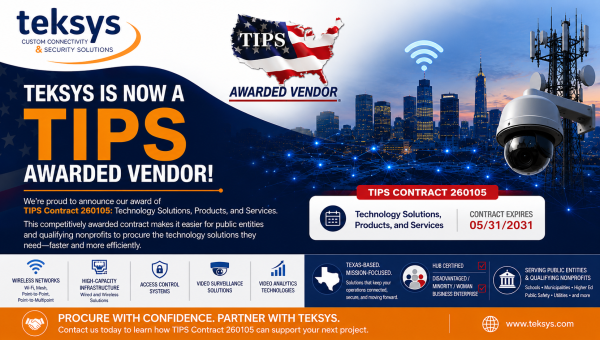
Teksys Inc. is proud to announce that we have been awarded a new contract through The Interlocal Purchasing System, better known as TIPS, under Contract 260105: Technology Solutions, Products, and Services.
This new TIPS contract gives public entities and qualifying nonprofit organizations a streamlined way to procure technology solutions from Teksys through a competitively solicited cooperative purchasing contract.
For schools, municipalities, law enforcement agencies, higher education institutions, and other public sector organizations, this means faster access to the technology infrastructure needed to support safety, connectivity, and mission-critical operations.
Making Technology Procurement Easier for Public Sector Organizations
Public procurement can be complex, time-consuming, and resource-intensive. TIPS helps simplify that process by allowing eligible members to utilize competitively awarded contracts where permitted by their local purchasing rules.
Through TIPS Contract 260105, eligible agencies can work with Teksys for technology solutions, products, and services without having to start the procurement process from scratch.
This is especially important for organizations that need to move quickly on projects involving public safety, network reliability, physical security, or critical infrastructure.
Supporting Public Safety, Connectivity, and Critical Infrastructure
Teksys designs and delivers custom connectivity and physical security solutions that help organizations maintain uninterrupted operations and protect critical infrastructure.
With more than 18 years of experience, Teksys supports public safety and mission-critical environments through proven communications and physical security technologies.
Our areas of expertise include:
- Wireless networks, including Wi-Fi, mesh, point-to-point, and point-to-multipoint systems
- High-capacity wired and wireless infrastructure
- Access control systems
- Video surveillance solutions
- Video analytics technologies
- Communications, networking, and security equipment procurement
Whether the need is a citywide surveillance expansion, a school safety upgrade, a wireless backhaul project, or a technology refresh for a public facility, Teksys can help agencies design, procure, deploy, and support the right solution.
A Better Path for Agencies with Urgent Technology Needs
Many public sector technology projects are driven by urgent operational needs. A school may need to improve campus safety. A municipality may need better visibility across parks, public spaces, or critical facilities. A law enforcement agency may need rapid deployment video capabilities for events or investigations. An IT department may need reliable connectivity where fiber is unavailable, delayed, or cost-prohibitive.
The TIPS cooperative purchasing contract gives eligible organizations another path to move these projects forward more efficiently.
By using TIPS Contract 260105, public entities can reduce procurement friction and focus more time on solving the actual operational challenge.
Teksys Is Ready to Help
Teksys is honored to be listed as a TIPS awarded vendor and looks forward to supporting public agencies and qualifying nonprofit organizations across Texas and beyond.
As a Texas-based systems integrator, Teksys brings practical field experience, engineering expertise, and a strong understanding of the needs of public sector customers. Our team works closely with customers to develop solutions that are reliable, scalable, and aligned with real-world operational requirements.
We are also proud to be recognized as a HUB and disadvantaged/minority/woman business enterprise, further supporting supplier diversity goals for agencies and institutions.
How to Use the TIPS Contract
Eligible TIPS members can procure Teksys solutions under:
TIPS Contract 260105
Technology Solutions, Products, and Services
Expiration Date: May 31, 2031
Purchase orders and vendor quotes should reference the TIPS contract number.
For questions about using the TIPS contract to procure Teksys solutions, contact our team today.
Ready to Start a Project?
If your organization is planning a technology, connectivity, or physical security project, Teksys can help you evaluate your options and determine whether TIPS Contract 260105 is the right procurement path.
Contact Teksys today to discuss your next project.

Teksys, Inc. was not intended to be just another service company. Our company is founded with the principal of being a technology partner for our clients, and we have proven ourselves as a leading provider of connectivity and security solutions that enable and transform the way communities and businesses gather, manage, and communicate information.
| Monday: | 8:30am - 6:00pm |
| Tuesday: | 8:30am - 6:00pm |
| Wednesday: | 8:30am - 6:00pm |
| Thursday: | 8:30am - 6:00pm |
| Friday: | 8:30am - 6:00pm |
| Saturday: | Closed |
| Sunday: | Closed |


