Beyond Surveillance: Turning Industrial Cameras into Customized Operational Intelligence
How AI Video Analytics Can Help Mining, Petrochemical, Energy, and Industrial Facilities Solve Problems Unique to Their Operations
Industrial facilities generate enormous amounts of operational data every day. Process control systems monitor pressures, temperatures, flow rates, equipment status, alarms, and thousands of other variables. Yet there is another source of operational information that many facilities already have deployed throughout their sites: video cameras.
Traditionally, those cameras have been treated primarily as security devices.
Artificial intelligence is beginning to change that.
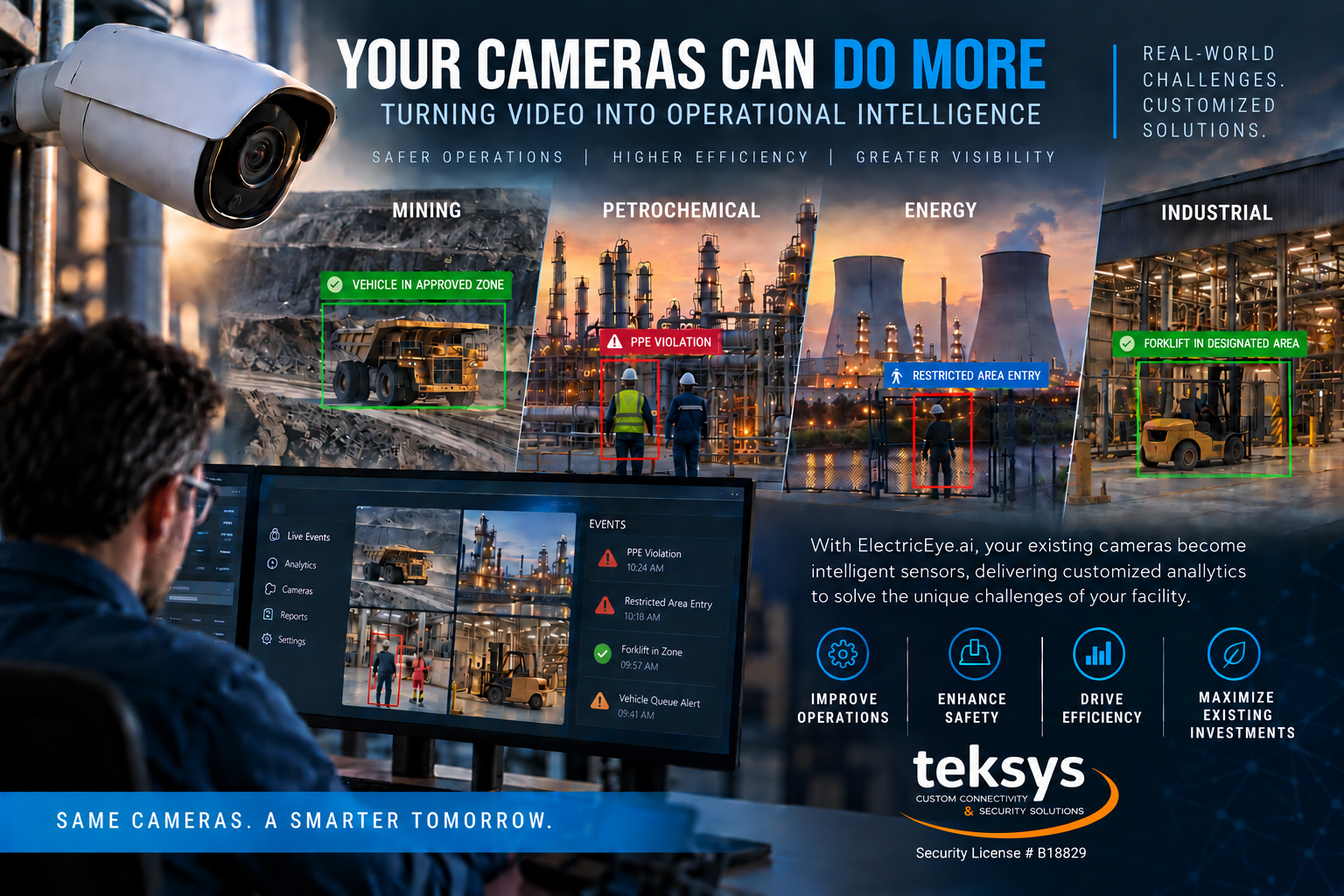
Platforms such as ElectricEye can transform existing camera infrastructure into intelligent visual sensors capable of analyzing what is happening within a facility and identifying specific behaviors, conditions, and events that matter to operations.
Instead of asking, “What analytics came with this camera?” industrial organizations can begin asking a much more valuable question:
“What operational problem do we need to solve, and can our cameras help us detect it?”
That shift opens an entirely new category of possibilities for Process Control Engineers, Facility Managers, Operations teams, and Technology Managers.
From Video Surveillance to Visual Operational Intelligence
Most industrial facilities already have extensive instrumentation. PLCs, SCADA systems, DCS platforms, environmental sensors, access control systems, and other technologies provide critical information about the operation.
But traditional sensors only measure what they were designed and installed to measure.
A pressure transmitter knows pressure.
A flow meter knows flow.
A proximity sensor knows whether something crossed its detection point.
A camera sees an entire scene.
Until recently, extracting useful operational information from that video required a person to continuously watch it or review recordings after an event occurred.
Modern AI video analytics are changing that equation.
ElectricEye's Active Scene Intelligence™ is designed to analyze the context and behavior occurring within a camera scene rather than simply identifying motion or classifying individual objects. The platform can work with existing IP cameras and supported video management systems, with processing performed through its cloud-based architecture.
For industrial facilities, the important concept is not simply that AI can recognize a person, truck, forklift, or piece of equipment.
The real opportunity is teaching the system to recognize situations that matter to your particular operation.
Your Facility Does Not Have Generic Problems. Your Analytics Shouldn't Be Generic Either.
A mining operation, refinery, chemical plant, power generation facility, pipeline terminal, manufacturing plant, and bulk material facility may all use cameras.
But their operational challenges can be completely different.
This is where customizable AI analytics become particularly valuable.
Instead of deploying a fixed library of generic analytics, organizations can identify a specific operational condition and determine whether existing cameras provide enough visual information for AI to recognize it.
For example, an industrial facility might want to identify:
- A vehicle entering a restricted operating area while equipment is active.
- Workers entering a designated area without required PPE.
- Personnel approaching equipment during a hazardous operating condition.
- Trucks arriving at the wrong loading position.
- Vehicles remaining in staging areas longer than expected.
- Forklifts or mobile equipment operating in pedestrian zones.
- Material accumulating where it normally should not.
- A gate, cabinet, access panel, or equipment enclosure remaining open.
- Personnel crossing a defined safety boundary during an active process.
- Unexpected activity around remote infrastructure.
- A loading or unloading operation that appears to deviate from the normal sequence.
- Congestion developing around loading racks, gates, scales, or processing areas.
- Equipment or vehicles positioned somewhere they should not be.
The objective isn't to replace the facility's control systems.
It is to add another layer of operational awareness using visual information that may already be available.
A Different Approach: Start With the Problem, Not the Camera
For Process Control Engineers, perhaps the most interesting aspect of customizable video analytics is the ability to approach video much like another source of process information.
Consider a hypothetical bulk material operation.
The problem might be:
Trucks occasionally enter a loading area before the previous vehicle has completely cleared the operating zone.
A traditional video system records the event.
A basic analytic might detect that two trucks are present.
A customized behavioral analytic could potentially be designed around the actual operational condition:
Detect when a second vehicle enters the defined loading zone while another vehicle remains within the active loading position.
Now the camera isn't merely recording video.
It is effectively providing a new visual operational event.
That event could generate an alert, provide video evidence, and give operations personnel immediate context about what occurred.
This is where AI video analytics become much more interesting for industrial operations.
Mining: Seeing Operational Conditions Across Large Sites
Mining and aggregate operations present a particularly compelling environment for visual intelligence.
These facilities often combine enormous operating areas, heavy mobile equipment, haul roads, conveyors, crushers, loading zones, stockpiles, restricted areas, and relatively limited personnel coverage.
Customized analytics could potentially help monitor conditions such as haul-truck interactions, pedestrian proximity to heavy equipment, restricted-zone entry, loading activity, material movement, queue conditions, or unusual activity around remote infrastructure.
Instead of requiring operators to continuously monitor dozens of camera feeds, AI can watch for specifically defined conditions and bring the relevant event to their attention.
The camera network becomes another set of eyes across the operation, but eyes that never become distracted by the other 47 video tiles on a monitor.
Petrochemical Facilities: Adding Context to Complex Operations
Refineries, chemical plants, terminals, and petrochemical facilities operate under tightly controlled procedures where context matters enormously.
A person standing next to a piece of equipment may be perfectly normal during maintenance but unusual during another operating state.
A vehicle entering an area may be routine at 10:00 AM but significant during a transfer operation.
This is precisely why behavioral and contextual analytics are more interesting than simple motion detection.
ElectricEye describes its approach as analyzing the overall scene and relationships between objects and actions, allowing the platform to distinguish routine activity from conditions that warrant attention.
Potential applications could include monitoring PPE requirements, restricted operating areas, loading rack activity, vehicle movement, maintenance zones, perimeter conditions, access to remote equipment, or other visually identifiable operating procedures.
The goal is not another avalanche of alarms.
It is better context around the events that actually matter.
Energy Facilities: Extending Visibility to Remote Infrastructure
Power generation facilities, substations, renewable energy sites, pipeline infrastructure, compressor stations, tank farms, and other energy assets often include locations that are difficult or expensive to continuously staff.
Video analytics can provide an additional layer of situational awareness across these environments.
A camera that was originally installed for security might also help identify unauthorized personnel, unexpected vehicles, unusual activity around equipment, access to controlled zones, or other facility-specific conditions.
Because ElectricEye can connect with supported existing camera infrastructure rather than requiring an entirely separate sensor network, organizations may be able to extract additional operational value from investments they have already made.
Turning Existing Cameras into Multipurpose Sensors
This may be the most important concept for technology and facility managers.
Organizations have spent years installing cameras throughout industrial facilities.
Those cameras already have:
Power. Network connectivity. Field of view. Infrastructure. Maintenance processes.
Historically, their primary job was to record video.
AI creates an opportunity to make those same cameras perform additional jobs.
One camera might simultaneously contribute to:
Security: Is someone entering a restricted area?
Safety: Is a worker entering that area without the appropriate PPE?
Operations: Is a vehicle occupying the area when it should be clear?
Process improvement: How frequently does congestion occur at this location?
Management: Are recurring events identifying a larger operational bottleneck?
Suddenly, the ROI conversation around video infrastructure changes considerably.
From Real-Time Alerts to Operational Trends
The value of AI analytics doesn't stop when an alert is generated.
ElectricEye includes analytics capabilities for reviewing event activity, severity, camera performance, and trends over time.
For industrial organizations, aggregated information can sometimes be even more valuable than individual events.
Imagine discovering that a particular loading area generates three times as many vehicle conflicts as comparable areas.
Or that PPE exceptions repeatedly occur during a specific shift.
Or that a particular gate routinely experiences congestion between 6:30 and 7:15 AM.
Or that one operational zone produces a disproportionate number of safety-related events.
Those observations can move video analytics beyond incident response and into continuous operational improvement.
Process Control Engineers and Facility Managers can begin using visual data to ask:
Why does this keep happening?
And more importantly:
What can we change to prevent it?
Test the Analytic Before You Deploy It
Another important capability for industrial applications is the ability to test customized analytics against representative scenarios.
ElectricEye's platform includes simulated event testing that allows video to be analyzed using custom monitoring prompts before deploying the analytic into a production environment.
That creates an iterative engineering process:
Identify the operational problem → Define the desired visual condition → Test it → Validate the results → Refine the analytic → Deploy → Measure performance.
For engineering teams, this approach is far more useful than purchasing an analytic simply because it appears on a manufacturer's feature list.
The technology is being configured around the process rather than forcing the process to fit the technology.
AI Doesn't Replace Process Control. It Adds Another Instrument.
For Process Control Engineers, perhaps the best way to think about technologies like ElectricEye is not as another surveillance platform.
Think of the camera as a software-defined visual sensor.
PLCs, SCADA, DCS, historians, instrumentation, and conventional sensors remain essential to industrial automation.
AI video analytics can complement those systems by detecting something traditional instrumentation often cannot easily measure:
What is physically happening in the scene?
That distinction is powerful.
The future industrial camera may no longer simply answer:
“What happened?”
It may help answer:
“What is happening right now, does it match how our facility is supposed to operate, and should someone know about it?”
The Best Analytics May Be the Ones That Haven't Been Created Yet
Every industrial facility contains operational challenges that are so specific they may never appear on a standard analytics datasheet.
That is precisely where customizable AI becomes interesting.
Instead of searching for a product that already has an analytic called “Detect Our Very Specific Problem,” organizations can begin with the problem itself.
What visual condition would indicate that the problem is occurring?
Which cameras can see it?
Can AI reliably recognize it?
What should happen when it does?
That conversation can bring together Process Control, Operations, Safety, Security, IT, OT, and Facility Management around a common objective.
And sometimes the solution may already be looking at you from a camera that has been hanging on the wall for years.
Ready to Explore What Your Cameras Could Detect?
At Teksys, we believe the next generation of industrial video systems will do far more than surveillance.
By combining existing camera infrastructure with customizable AI platforms such as ElectricEye, mining, petrochemical, energy, manufacturing, and industrial organizations can explore new ways to improve safety, operational visibility, security, and process efficiency without starting with an entirely new sensor infrastructure.
The starting point is simple:
Tell us about a problem at your facility that you wish your systems could see.
We'll help determine whether your existing cameras and customized AI analytics can turn that problem into actionable information.
Teksys, Inc. was not intended to be just another service company. Our company is founded with the principal of being a technology partner for our clients, and we have proven ourselves as a leading provider of connectivity and security solutions that enable and transform the way communities and businesses gather, manage, and communicate information.
| Monday: | 8:30am - 6:00pm |
| Tuesday: | 8:30am - 6:00pm |
| Wednesday: | 8:30am - 6:00pm |
| Thursday: | 8:30am - 6:00pm |
| Friday: | 8:30am - 6:00pm |
| Saturday: | Closed |
| Sunday: | Closed |


