Beyond Fiber: How Axis Cameras and Ceragon Private 5G Are Transforming Video Surveillance for Airports, Cities, Schools, and Enterprises
Deploy Security Cameras Where You Need Them, Not Just Where Network Cables Can Reach
The Challenge: Expanding Video Surveillance Without Expanding Infrastructure Costs
For airports, municipalities, school districts, and large enterprises, video surveillance has become an essential component of protecting people, facilities, and critical infrastructure.
However, expanding surveillance coverage across large properties presents a familiar challenge: How do you connect cameras in locations where traditional network infrastructure is unavailable, expensive to install, or difficult to maintain?
Consider the challenges facing today's security and IT professionals:
-
An airport needs additional cameras along its perimeter, remote parking areas, or airfield support facilities.
-
A city wants to expand public safety surveillance into parks, intersections, pedestrian corridors, and public spaces.
-
A school district needs to secure athletic fields, parking lots, and remote campus facilities.
-
A large enterprise wants to monitor expansive industrial sites, warehouses, and outdoor operational areas.
Traditionally, these projects require installing fiber-optic cable, constructing underground pathways, obtaining permits, and coordinating construction activities that can disrupt daily operations.
But what if organizations could significantly reduce their dependence on new wired infrastructure while maintaining the security, performance, and centralized management required for professional video surveillance?
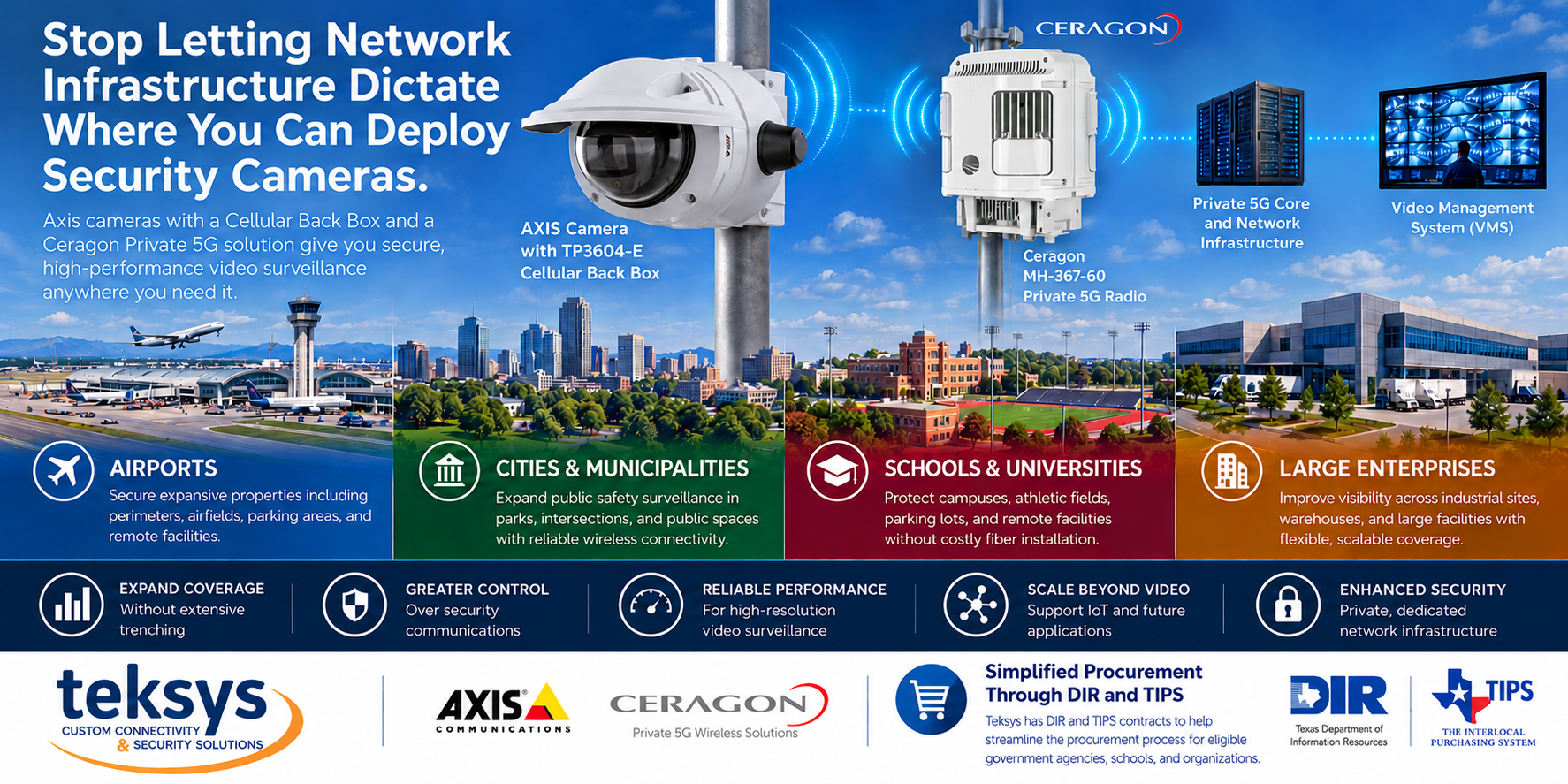
The combination of Axis Communications cellular-enabled camera technology and Ceragon private 5G wireless networking provides a compelling alternative.
At Teksys, we believe this combination deserves serious consideration by organizations planning their next generation of security infrastructure.
Introducing the AXIS TP3604-E Cellular Back Box
Axis Communications has introduced the AXIS TP3604-E Cellular Back Box, a solution designed to connect compatible Axis network cameras directly to a private cellular network.
Rather than requiring a dedicated Ethernet connection back to a network switch, the cellular back box enables compatible Axis cameras to communicate over an organization's private 4G or 5G network.
The solution supports:
-
AXIS P32 Series dome cameras.
-
AXIS P14 Series bullet cameras, using the appropriate adapter plate.
-
Private cellular connectivity using a SIM card.
-
Outdoor installations with IP66 weather protection and IK10 impact resistance.
-
Integration with compatible video management platforms.
-
Video streaming throughput up to 200 Mbps at the back box, subject to available wireless network capacity.
The device also incorporates Axis cybersecurity technologies, including secure boot, encrypted storage, and hardware-based security features.
For organizations operating in the United States, the AXIS TP3604-E US model supports the CBRS frequency bands B48 and n48, providing a potential path for deployment on compatible private cellular infrastructure.
The important advantage is installation flexibility.
Where suitable private cellular coverage and electrical power are available, security cameras can be deployed without installing a new fiber or Ethernet connection to each location.
For example, an existing light pole with appropriate electrical power could become a new video surveillance location without requiring a trench across a parking lot or roadway.
This approach opens new possibilities for expanding security coverage across large and geographically dispersed environments.
Why Pair Axis Cameras with a Ceragon Private 5G Network?
While cellular-enabled cameras provide the connection to the network, the underlying wireless infrastructure determines how effectively that connection performs.
This is where Ceragon's private wireless networking solutions become especially valuable.
Ceragon provides end-to-end private 4G/5G wireless solutions designed for organizations requiring secure, high-performance connectivity across large or complex environments.
Unlike public cellular services, a private cellular network is designed around the organization's operational requirements.
This gives organizations greater control over network coverage, connected devices, traffic management, security policies, and network performance.
1. Expand Coverage Without Extensive Trenching
Installing fiber-optic infrastructure across airports, municipal properties, and industrial campuses can be expensive and time-consuming.
Construction may involve excavation, pavement restoration, underground utility coordination, permitting, and interruptions to normal operations.
With a properly designed Ceragon private cellular network, multiple camera locations can communicate wirelessly through strategically positioned radio infrastructure.
This can substantially reduce the amount of new cabling required and make previously impractical camera locations more accessible.
2. Gain Greater Control Over Security Communications
Public cellular networks serve thousands of users, and organizations typically have limited control over network congestion, resource allocation, and service availability.
A private 5G network provides a dedicated environment where authorized devices can connect under organization-defined security and operational policies.
This is particularly valuable for public safety and critical infrastructure applications, where organizations want to maintain control over how surveillance information moves across their network.
Private SIM authentication, network segmentation, and appropriately configured encryption can help protect communications while supporting centralized network administration.
3. Support Reliable Video Surveillance Performance
Professional video surveillance places significant demands on network infrastructure.
Multiple high-resolution cameras can generate substantial upstream traffic, particularly when video is transmitted continuously to a centralized video management system.
A properly engineered private 5G network can prioritize critical applications, allocate network resources, and support predictable performance under planned operating conditions.
Unlike general-purpose wireless connectivity, a purpose-designed private network can be engineered around surveillance bandwidth, coverage, latency, and availability requirements.
Performance still depends on radio conditions, spectrum availability, network capacity, and traffic engineering, making professional system design essential.
4. Scale Beyond Video Surveillance
One of the most compelling benefits of investing in private 5G infrastructure is its potential to support applications beyond security cameras.
The same private network may also support compatible:
-
IoT sensors and environmental monitoring systems.
-
Operational communications and remote equipment monitoring.
-
Smart city and transportation technologies.
-
Connected industrial devices.
-
Emergency management and mobile applications.
Instead of constructing separate wireless systems for every new application, organizations can establish a shared communications foundation designed to support future requirements.
Real-World Applications: Where This Technology Makes Sense
Airports: Secure Large Properties Without Disrupting Operations
Airports present some of the most challenging environments for surveillance infrastructure.
Their expansive properties include airfields, perimeter fencing, parking facilities, maintenance areas, cargo facilities, and remote access roads.
Installing traditional network cabling in these locations can be complicated by construction restrictions, operational requirements, and the need to minimize disruption.
A Ceragon private 5G network combined with compatible Axis cameras can provide an alternative approach for connecting cameras in areas where network cabling is impractical.
Potential applications include perimeter surveillance, remote parking facilities, service roads, cargo areas, and temporary construction zones.
The ability to deploy additional surveillance locations using existing electrical infrastructure can be particularly valuable when responding to changing security requirements.
Cities and Municipalities: Expand Public Safety Video Coverage
Cities increasingly depend on video surveillance to improve situational awareness, support emergency response, and monitor public spaces.
However, public safety camera locations do not always align with existing municipal fiber networks.
Parks, intersections, pedestrian corridors, parking facilities, and other public spaces may be located far from available communications infrastructure.
Private 5G enables municipalities to consider a different approach.
Rather than extending fiber to every new camera, cities can establish private wireless coverage and connect compatible cameras wherever suitable network coverage and electrical power are available.
This approach can help municipalities:
-
Expand public safety surveillance more efficiently.
-
Connect cameras in parks and remote public facilities.
-
Reduce construction requirements at difficult locations.
-
Integrate remote camera feeds into centralized monitoring operations.
-
Establish communications infrastructure for future smart city applications.
For cities managing multiple departments and geographically dispersed assets, the ability to share a purpose-built wireless infrastructure may deliver significant long-term value.
Schools and Universities: Protect the Entire Campus
School districts and universities often operate facilities spread across multiple buildings, parking areas, athletic fields, and outdoor spaces.
Although many campuses have established network infrastructure inside their buildings, providing connectivity to outdoor locations can be significantly more challenging.
A private cellular network can extend communications coverage to areas that might otherwise require costly underground cabling.
Potential applications include:
-
Athletic stadiums and sports complexes.
-
Student and staff parking areas.
-
Remote campus entrances.
-
Bus transportation facilities.
-
Outdoor gathering areas.
-
Temporary buildings and construction projects.
For districts and universities with multiple surveillance expansion projects, private cellular technology offers an opportunity to evaluate a more flexible long-term network architecture.
It can also complement existing fiber and wireless infrastructure rather than requiring organizations to replace their current investments.
Large Enterprises: Improve Visibility Across Complex Facilities
Manufacturing plants, logistics centers, distribution campuses, energy facilities, and large commercial properties frequently need surveillance coverage across expansive outdoor environments.
These locations may include equipment yards, loading areas, remote gates, perimeter roads, and facilities where installing new communications pathways would interfere with operations.
Private 5G provides a potential solution for extending video connectivity without the limitations associated with deploying new physical cabling to every location.
For enterprise IT and security teams, the value extends beyond camera connectivity.
A private network can provide a common wireless foundation for security, operational monitoring, and future connected applications.
Private 5G vs. Fiber and Wi-Fi: Choosing the Right Technology
Private 5G is not intended to replace every wired or wireless network.
Fiber-optic infrastructure remains an excellent choice where high-capacity, dedicated connections are readily available. Wi-Fi continues to serve many indoor and localized applications effectively.
However, private 5G becomes particularly attractive when organizations need wide-area wireless coverage, controlled network access, and the ability to connect devices across large outdoor environments.
| Consideration | Fiber | Traditional Wi-Fi | Private 5G |
|---|---|---|---|
| New underground cabling | Often required | Not always required | Not required at camera locations |
| Wide outdoor coverage | Requires distributed physical infrastructure | Multiple access points may be needed | Designed for broad coverage |
| Mobility support | Limited | Available with appropriate design | Strong mobility capabilities |
| Dedicated network control | Yes | Yes, with proper configuration | Yes |
| Installation flexibility | Limited by cable pathways | Flexible within coverage | Flexible within cellular coverage |
| High-bandwidth performance | Excellent | Depends on design and interference | Depends on spectrum and capacity |
| Best application | High-capacity fixed infrastructure | Localized wireless connectivity | Wide-area and mobile connectivity |
The strongest architecture is often a hybrid approach, using fiber where it makes sense, private 5G where wireless coverage offers advantages, and existing networks wherever they can be leveraged effectively.
The Importance of Proper Network Design
Although the benefits of private 5G are compelling, successful deployments require more than simply installing cellular-enabled cameras.
Video surveillance is an uplink-intensive application. Network capacity must be evaluated based on camera resolution, compression settings, frame rates, expected traffic, and the number of simultaneous video streams.
Organizations should also consider:
-
RF coverage and interference analysis.
-
Spectrum availability and regulatory requirements.
-
Compatibility between camera cellular interfaces and private network equipment.
-
Power availability at camera locations.
-
Video management system integration.
-
Network security and authentication.
-
Redundancy and operational availability.
-
Long-term maintenance and support.
For example, the AXIS TP3604-E US supports specific private cellular frequency bands and standalone network modes. The selected Ceragon infrastructure must be verified for compatibility with these requirements.
Additionally, integrating cameras into an existing video management system may require defined IP addressing and network configuration rather than relying on traditional camera discovery protocols.
These considerations reinforce the importance of working with an experienced technology integration partner.
How Teksys Can Help
At Teksys, we specialize in combining advanced video surveillance technologies with high-performance wireless networking solutions.
Our experience in video surveillance, wireless backhaul, network infrastructure, and systems integration allows us to approach projects from both the security and communications perspectives.
By bringing together Axis Communications cameras and Ceragon private wireless networking technology, Teksys can help organizations evaluate and develop solutions tailored to their specific requirements.
Our services include:
-
Site Assessment and Feasibility: Evaluating coverage requirements, available infrastructure, camera locations, and potential deployment challenges.
-
Wireless Network Design: Developing private wireless architectures based on RF coverage, capacity, and operational requirements.
-
Video Surveillance Integration: Selecting compatible Axis cameras and integrating them with existing or new video management systems.
-
Installation and Commissioning: Deploying, configuring, testing, and optimizing the communications and surveillance infrastructure.
-
Ongoing Support: Providing maintenance, troubleshooting, and network performance support to help sustain system reliability.
Our goal is not simply to install more cameras. It is to help organizations develop surveillance systems that are practical to deploy, manageable to operate, and ready to accommodate future needs.
Simplified Procurement Through Teksys DIR and TIPS Contracts
At Teksys, we understand that selecting the right technology is only part of the process. For public agencies, educational institutions, and other organizations, navigating procurement requirements can be just as challenging as designing and deploying the solution.
To help streamline purchasing, Teksys offers procurement options through the Texas Department of Information Resources (DIR) and The Interlocal Purchasing System (TIPS).
These cooperative purchasing programs provide eligible customers with established contracting vehicles that can help simplify the acquisition of technology products and related services, reduce administrative burdens, and accelerate project implementation.
Teksys Texas DIR Contracts:
-
DIR-CPO-5287: Data Communications & Networking Equipment and Related Services.
-
DIR-CPO-5406: Mobile Digital Video Products & Accessories.
Teksys TIPS Cooperative Purchasing: Teksys also participates in the TIPS cooperative purchasing program, providing additional purchasing options for eligible organizations, subject to applicable contract availability and scope.
Teksys TIPS Contract:
-
260105: Technology Solutions, Products, and Services
Whether your organization is planning a municipal surveillance expansion, an airport security upgrade, a school campus improvement, or a large-scale wireless infrastructure project, Teksys can help identify an appropriate procurement pathway for the proposed equipment and services.
Our goal is to make the entire process easier, from initial system design and technology selection to procurement, installation, and ongoing support.
Contact Teksys to discuss your project and determine which available procurement contract may best support your organization's purchasing requirements.
The Future of Video Surveillance Is More Connected and More Flexible
The ability to place security cameras where they provide the greatest operational value, rather than where network infrastructure happens to exist, represents an important shift in surveillance system design.
Axis cellular-enabled camera technology and Ceragon private 5G networking offer organizations an opportunity to rethink how they extend video surveillance across large properties.
For airports, municipalities, school districts, and enterprises, the potential benefits include reduced infrastructure construction, more flexible deployment options, greater control over communications, and a scalable foundation for future connected technologies.
The question is no longer simply where you can install a security camera. It is where you need visibility, and what network architecture makes that visibility possible.
Ready to Expand Your Video Surveillance Coverage?
Whether you're responsible for securing an airport, municipality, school campus, or large enterprise, Teksys can help you explore how Axis cellular-enabled cameras and Ceragon private 5G networking can improve coverage while reducing dependence on costly wired infrastructure.
With Teksys's Texas DIR contracts and TIPS cooperative purchasing options, eligible organizations may also benefit from a more streamlined procurement process.
Schedule a consultation with Teksys today to discuss your security requirements, wireless network design, and available purchasing options.
Teksys, Inc. | Advanced Security & Wireless Connectivity Solutions
Texas Security License #B18829

Teksys, Inc. was not intended to be just another service company. Our company is founded with the principal of being a technology partner for our clients, and we have proven ourselves as a leading provider of connectivity and security solutions that enable and transform the way communities and businesses gather, manage, and communicate information.
| Monday: | 8:30am - 6:00pm |
| Tuesday: | 8:30am - 6:00pm |
| Wednesday: | 8:30am - 6:00pm |
| Thursday: | 8:30am - 6:00pm |
| Friday: | 8:30am - 6:00pm |
| Saturday: | Closed |
| Sunday: | Closed |


