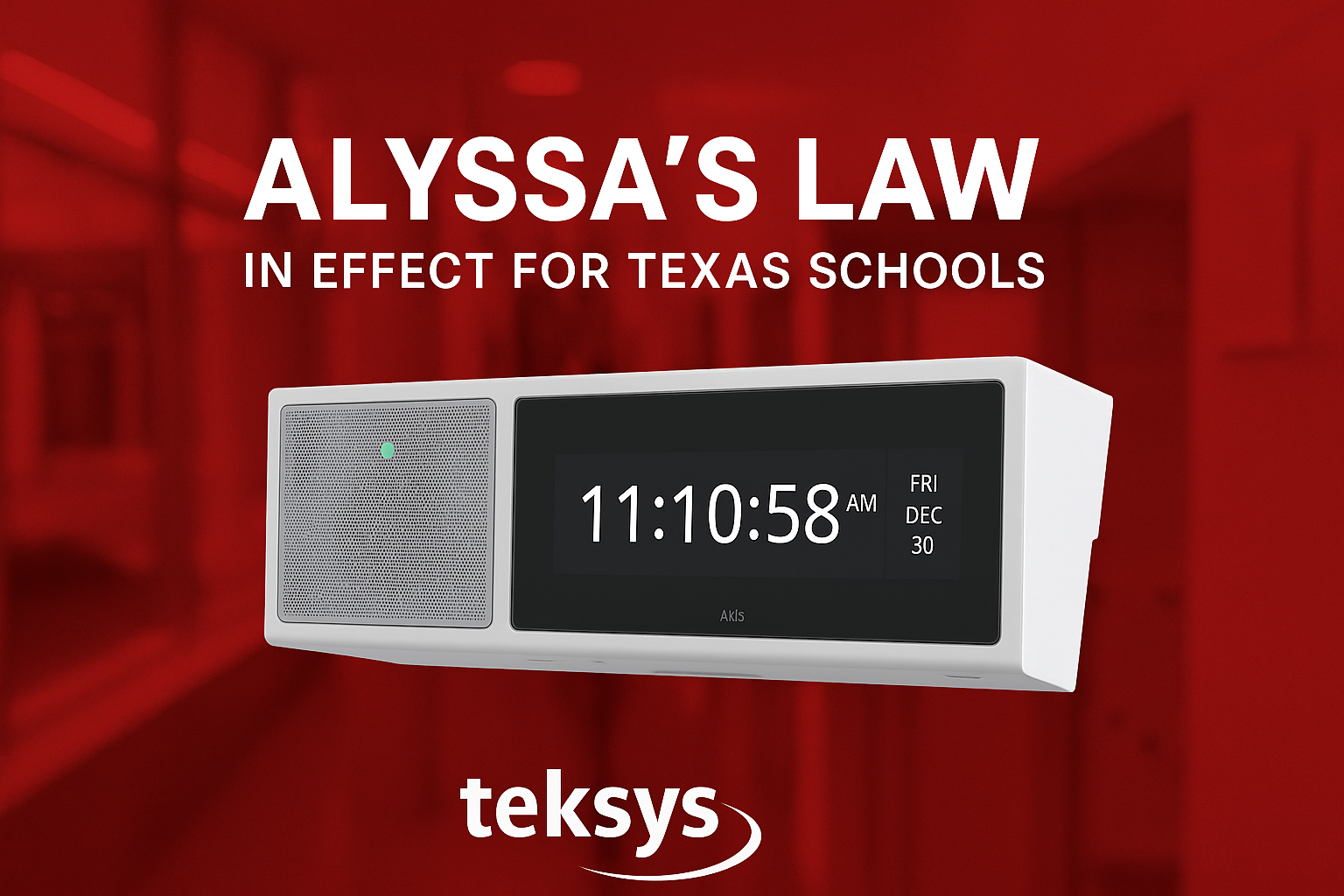
Alyssa’s Law – What It Means for Texas Schools
1. The Big Picture
Alyssa’s Law is a pivotal piece of legislation aimed at strengthening the safety infrastructure of K-12 institutions. In Texas, the law was enacted via Senate Bill 838 (88th R.S.), also referred to by some sources as paired with House Bill 669.
Under SB 838:
-
Every public school district and open-enrollment charter school in Texas must provide silent panic alert technology in each classroom. Texas Legislative Online+1
-
The silent panic alert system must allow immediate contact with the school’s or district’s emergency services, as well as local law enforcement, fire, and health departments. Texas School Safety Center+1
-
Implementation begins with the 2025-2026 school year. Texas Legislative Online+1
2. Why This Matters for Texas Schools
-
Faster response times: Silent alerts allow staff to summon help discreetly, without alerting a potential intruder or creating mass panic. Make Our Schools Safe
-
Compliance imperative: Failure to comply by the 2025-2026 deadline could expose districts to legal, financial, and reputational risk. Network Cabling Services+1
-
Funding and procurement options: Schools can use the school safety allotment (per Texas Education Code § 48.115) or other available funds to comply, and may follow customary procurement processes. Texas School Safety Center+1
3. Key Requirements Texas Schools Should Plan For
| Requirement | Details |
|---|---|
| Silent panic alert technology in each classroom | Every classroom must have a system that provides immediate, discreet alerting. Texas Legislative Online+1 |
| Direct connection to emergency services | The alert must reach school or district emergency services and law enforcement/fire/health departments. Texas School Safety Center+1 |
| Distinct from phones/devices | The law clarifies that this requirement does not replace other classroom communication devices like phones. Texas Legislative Online |
| Timeline & procurement flexibility | Must be implemented by 2025-26; schools may use available funds and follow their existing procurement process. Texas School Safety Center+1 |
4. Implications for School IT & Safety Leaders
-
Technology evaluation: Look beyond simple panic buttons—evaluate systems that integrate with existing communications, mass-notification, digital signage, and networked devices.
-
Integration with campus systems: Silent alert is one layer. Effective systems often tie into audio-visual, access control, surveillance, and mass-notification platforms.
-
Procurement path: Schools should develop their procurement strategy now to avoid rush-install this fall. Consider vendor selection, infrastructure readiness, training, and testing.
-
Budget planning and funding: Leverage school safety allotment, grants, or other funds. Document budget/resourcing now so implementation isn’t rushed.
-
Training and policy: A technology is only as good as the people using it. Staff training, regular drills, and clear responsibility matrices are critical.
5. How Teksys Can Help
At Teksys, we’ve been working with Texas K-12 and Higher Ed institutions for years on communications, network audio/visual, and security-adjacent infrastructure (while noting we do not provide cybersecurity or asset-management solutions).
Here’s how we support your Alyssa’s Law compliance roadmap:
-
We help design silent panic alert systems that integrate with your broader campus infrastructure (audio, display, notification).
-
We guide you through the procurement process under the Texas DIR contract (DIR‑CPO‑5287) when eligible, streamlining procurement and reducing administrative burden.
-
We assist in pilot planning, installation phasing (classroom-by-classroom or building-by-building), infrastructure verification (network, PoE, display/strobe), and training for staff.
-
We provide vendor/technology alignment (such as audio/visual/network display devices that supplement panic alert technologies)—helping you get more value and flexibility in your investment.
6. Next Steps for Your District
-
Conduct an audit of current classroom alert/notification capability.
-
Identify infrastructure gaps: network readiness, displays, speakers, strobe/visual devices, mass-notification integration.
-
Select alert-system technology: ensure it meets Texas law’s direct-connect requirement and integrates with your workflows.
-
Create a rollout plan: pilot a wing or building, then scale. Include training, testing, and policy updates.
-
Document your funding strategy: specify how you’ll use allotment/school-safety funds, timeline, vendor procurement, and deployment.
-
Partner with experts: outsource vendor-assessment, installation, integration, and training to reduce internal burden.
Compliance with Alyssa’s Law isn’t just a checkbox—it’s a strategic opportunity to elevate your campus safety, integrate modern communications, and future-proof your notification systems. If you’re a School IT Manager, Safety Director, or member of your district’s procurement team, now is the time to plan. Reach out to Teksys today and let us partner with you to implement a modern, compliant solution.
📄 Download the full Texas law text (SB 838)
Note: While the above link points to our product datasheet for convenience, please refer to the official bill text for detailed legal language.
Teksys, Inc. was not intended to be just another service company. Our company is founded with the principal of being a technology partner for our clients, and we have proven ourselves as a leading provider of connectivity and security solutions that enable and transform the way communities and businesses gather, manage, and communicate information.
| Monday: | 8:30am - 6:00pm |
| Tuesday: | 8:30am - 6:00pm |
| Wednesday: | 8:30am - 6:00pm |
| Thursday: | 8:30am - 6:00pm |
| Friday: | 8:30am - 6:00pm |
| Saturday: | Closed |
| Sunday: | Closed |


