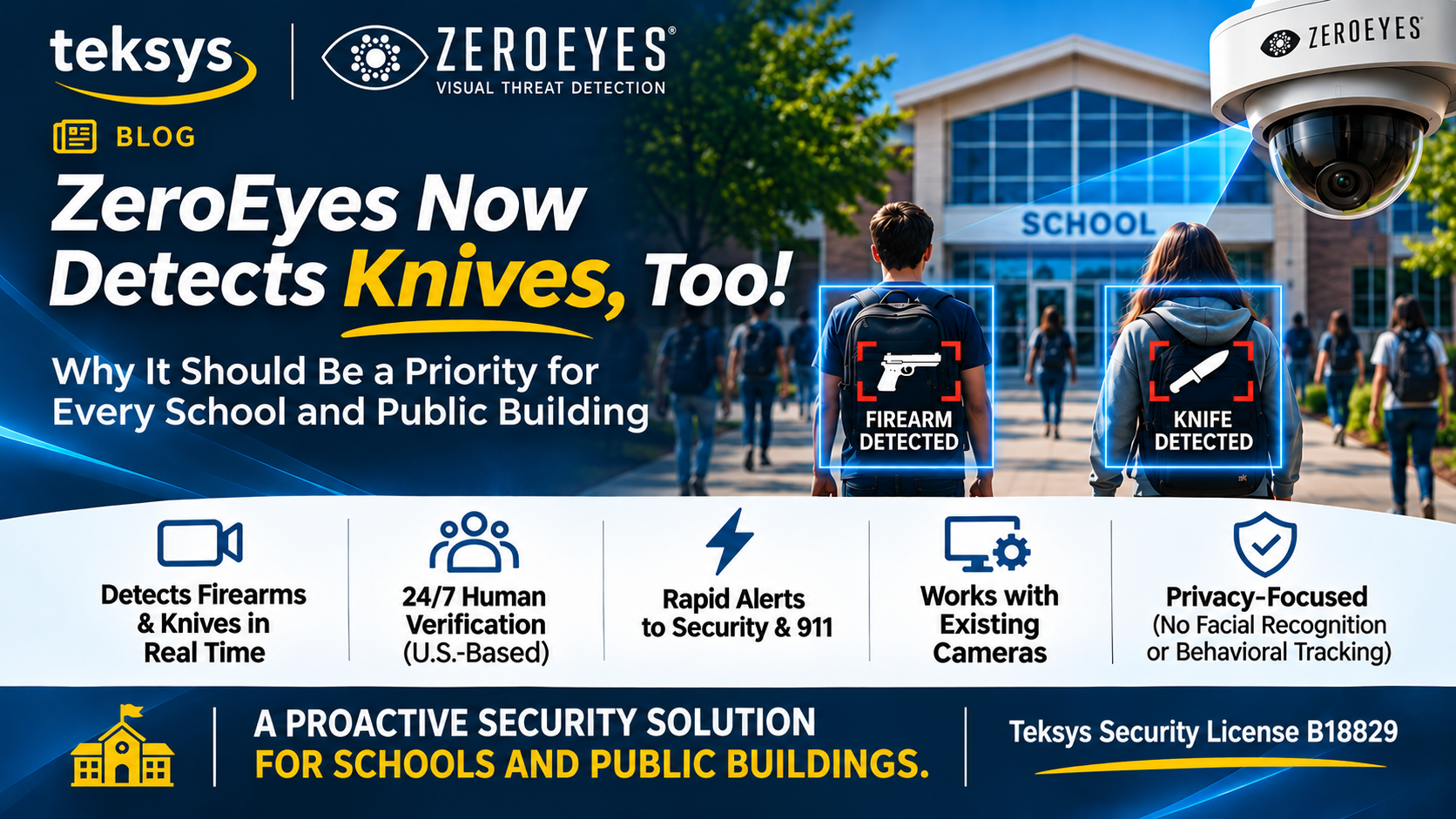
Beyond Gun Detection: ZeroEyes Now Detects Knives, Too. Why Every School and Public Building Should Take Notice.
Your Security Cameras Can Do More Than Record an Emergency. They Can Help Identify One.
Every day, millions of students enter classrooms, employees report to work, and families visit public buildings with the expectation that these environments are safe.
Yet school administrators, city officials, and security professionals face an increasingly important question:
If someone enters your facility carrying a visible weapon, how quickly would your security team know?
For many organizations, the answer depends on someone noticing the threat, recognizing the danger, and communicating that information to the appropriate authorities.
Traditional surveillance cameras provide valuable evidence and situational awareness. However, without specialized analytics and monitoring, they typically depend on someone actively watching the video to identify a developing threat.
What if your existing cameras could help identify visible firearms and knives before an incident escalates?
That is the opportunity presented by ZeroEyes' expanded AI-powered Visual Threat Detection (VTD) technology.
ZeroEyes Now Detects Both Firearms and Knives
ZeroEyes, known for its AI-powered firearm detection technology, has expanded its capabilities to include Visual Knife Detection.
This advancement allows security professionals to use compatible existing surveillance cameras to identify two important categories of visible weapon threats:
-
Firearms: Detecting visible, brandished firearms that may indicate an emerging threat.
-
Knives: Detecting visible, brandished knives that may present an immediate danger to students, employees, or visitors.
By combining artificial intelligence with human verification, ZeroEyes provides an additional layer of awareness that can help security personnel and first responders make more informed decisions.
For schools, colleges, government buildings, and other public facilities, this means existing camera infrastructure may now support a broader proactive threat detection strategy.
Why Knife Detection Matters for School Safety
When discussing school security, conversations frequently focus on firearms. However, threats involving knives and other bladed weapons also deserve attention.
A dangerous situation involving a knife can develop quickly, particularly in crowded environments such as hallways, cafeterias, school entrances, and common areas.
School security personnel cannot physically monitor every location simultaneously. Even facilities with extensive surveillance coverage may have blind spots in their ability to recognize threats in real time.
Having cameras installed is not the same as having an automated threat detection system.
ZeroEyes Visual Threat Detection helps address this challenge by continuously analyzing video from designated cameras for visible, brandished firearms and knives.
When a potential weapon is detected, the system initiates a human verification process and, when verified, communicates actionable information to the appropriate security personnel and emergency responders.
This capability can provide valuable additional time to initiate established emergency procedures.
Importantly, the technology complements rather than replaces school resource officers, trained security personnel, access control, emergency communications, and comprehensive safety planning.
How ZeroEyes Visual Threat Detection Works
ZeroEyes combines computer vision analytics, continuous monitoring, human verification, and rapid notifications.
1. AI-Powered Weapon Detection
ZeroEyes analyzes video streams from compatible security cameras to identify visible, brandished firearms and knives.
The system operates continuously, 24 hours a day, 365 days a year.
2. Human Verification
Potential detections are reviewed by ZeroEyes' U.S.-based operations team, staffed by military and law enforcement veterans.
According to ZeroEyes, verification can occur in as little as 3–5 seconds.
This human-in-the-loop approach helps distinguish potential threats from false detections before alerts are dispatched.
3. Rapid Threat Notification
Once a threat is verified, notifications can be delivered to designated security personnel and local emergency dispatch centers through supported ZeroEyes applications, integrations, and communication procedures.
Alerts can include actionable information such as images, weapon descriptions, and location details to support situational awareness.
4. Faster, More Informed Response
By receiving verified threat information sooner, security personnel and first responders may be better positioned to implement emergency response procedures.
The objective is simple: Identify potential danger earlier, communicate it quickly, and give responders more time to act.
Detection does not guarantee that an incident will be prevented, but it can strengthen an organization's overall emergency readiness.
Why Every School Should Evaluate Visual Threat Detection
Schools already invest significant resources in surveillance cameras, access control, intercoms, emergency notifications, and security personnel.
Yet many of these systems operate independently or provide information primarily after an incident has begun.
Visual Threat Detection offers an opportunity to make existing surveillance investments more useful.
For school districts, the potential benefits include:
Greater awareness: Identify visible weapon threats without relying exclusively on personnel watching live video.
Better use of existing cameras: Add compatible AI analytics without necessarily replacing the entire surveillance system.
Faster communication: Provide verified information to security personnel and emergency responders.
Support for emergency planning: Integrate detection and notification into established school safety procedures.
Privacy-conscious technology: ZeroEyes states that its solution does not use facial recognition or behavioral tracking.
For school IT directors, this also creates an opportunity to contribute directly to campus safety using infrastructure they already manage.
Instead of asking only how many cameras are installed, administrators should also ask:
How effectively are those cameras helping us recognize and respond to a threat?
Public Buildings Need Proactive Protection, Too
The benefits of Visual Threat Detection extend beyond schools.
Government facilities, libraries, community centers, transit stations, healthcare facilities, and other publicly accessible buildings face similar challenges.
Many must balance open public access with the need to protect employees and visitors.
ZeroEyes can provide another layer of situational awareness in locations such as:
-
Municipal buildings: City halls, administrative offices, and public service facilities.
-
Libraries and community centers: Buildings serving families and large numbers of visitors.
-
Higher education campuses: Academic buildings, student centers, and other common areas.
-
Healthcare facilities: Hospitals, clinics, and other facilities with publicly accessible spaces.
-
Transit facilities: Stations, terminals, and transportation centers.
-
Commercial and industrial properties: Corporate campuses, manufacturing facilities, and distribution centers.
For public safety directors and facility managers, the ability to detect visible weapon threats through existing cameras can become an important component of a broader security modernization strategy.
You May Already Have Much of the Infrastructure You Need
One of the most compelling aspects of ZeroEyes is its ability to work with compatible existing IP surveillance systems.
Organizations may not need to replace all their cameras or completely redesign their video security infrastructure.
Instead, a deployment assessment can determine whether their existing cameras, network, and video management system meet the requirements for ZeroEyes integration.
Considerations include camera resolution, image quality, field of view, network connectivity, available power, and placement of the ZeroEyes analytics appliance.
ZeroEyes identifies minimum camera requirements that include 720p resolution, 5 frames per second, 16:9 aspect ratio, and ONVIF compatibility.
Actual detection performance and suitability depend on camera placement, visibility, environmental conditions, and the specific deployment design.
This makes a professional site and infrastructure assessment an important first step.
Why Waiting Until After an Incident Is the Wrong Time to Evaluate Security
Fire alarms, intrusion detection systems, and emergency notification platforms are installed because organizations recognize the value of early warning.
Visual weapon detection deserves consideration through the same preparedness mindset.
A security system should not simply document what happened. Wherever technically feasible, it should also help security teams recognize emerging danger and respond appropriately.
The time to evaluate a threat detection system is before an emergency, not during one.
For schools and public facilities, that means reviewing existing camera coverage, identifying priority areas, assessing integration opportunities, and determining how verified alerts would fit into emergency response procedures.
It also means understanding the limitations of the technology and ensuring it forms part of a comprehensive security program.
How Teksys Helps Texas Schools and Public Facilities Implement ZeroEyes
At Teksys, Inc., we specialize in designing, deploying, and integrating advanced physical security and wireless connectivity solutions.
As part of our commitment to helping Texas communities improve public safety, we offer ZeroEyes Visual Threat Detection solutions for educational institutions, municipalities, and commercial facilities.
Our team can assist with:
-
Existing Camera Assessments: Evaluate whether your current surveillance infrastructure can support ZeroEyes.
-
System Design and Integration: Identify camera coverage requirements and coordinate integration with compatible security infrastructure.
-
Network Readiness: Review connectivity, bandwidth, power, and equipment requirements.
-
Implementation Planning: Develop a deployment strategy based on your facilities, priorities, and budget.
-
Security System Modernization: Identify opportunities to strengthen your overall surveillance and emergency notification capabilities.
Teksys also offers purchasing options through Texas DIR and TIPS cooperative procurement contracts, subject to applicable contract scope and purchasing requirements.
Our goal is to help organizations make informed decisions about technologies that can improve safety while maximizing the value of their existing infrastructure.
The Next Step in School and Public Building Safety Starts With a Conversation
The introduction of knife detection represents another important advancement in AI-powered physical security.
For schools and public buildings, the question is no longer simply whether surveillance cameras are installed.
The question is whether those cameras are being used to their full potential to help protect people.
ZeroEyes Visual Threat Detection provides an opportunity to move beyond passive video recording toward earlier threat identification and more informed emergency response.
Every school district, municipality, and public facility should consider whether this technology belongs in its security strategy.
Don't wait for an emergency to discover what your cameras could have helped you see.
Let Teksys Help You Evaluate Your Options
Whether you're a school superintendent, IT director, security administrator, city official, or concerned parent, our team would welcome the opportunity to explain how ZeroEyes works and discuss practical ways to bring this technology to your facilities.
Contact Teksys today to schedule a ZeroEyes Visual Threat Detection consultation.
https://www.teksys.com/contact-us
Teksys, Inc. | Custom Connectivity & Security Solutions
Security License B18829
Teksys + ZeroEyes: Faster Alerts. Smarter Detection. Safer Communities.

Teksys, Inc. was not intended to be just another service company. Our company is founded with the principal of being a technology partner for our clients, and we have proven ourselves as a leading provider of connectivity and security solutions that enable and transform the way communities and businesses gather, manage, and communicate information.
| Monday: | 8:30am - 6:00pm |
| Tuesday: | 8:30am - 6:00pm |
| Wednesday: | 8:30am - 6:00pm |
| Thursday: | 8:30am - 6:00pm |
| Friday: | 8:30am - 6:00pm |
| Saturday: | Closed |
| Sunday: | Closed |


